

Grizzly or Black Bear: How to Tell Them Apart and What to Do in an Encounter
Hump, ears, claws, facial profile: five field marks to identify the species, follow NPS guidance, and choose and use bear spray.
By Victoria Boissonade · · 8 min read
Black bears live in more than 30 U.S. national parks, while grizzlies are found in only a handful. Confusing the two species is common, and it has direct consequences: NPS guidance for dealing with a grizzly is not the same as the advice for a black bear. Color is useless for telling them apart, since both species range from light brown to deep black. Every visitor to America’s national parks needs to answer two essential questions: how can you tell the two species apart in the field, and what should you do if one crosses your path?
Grizzly or black bear: five ways to tell them apart
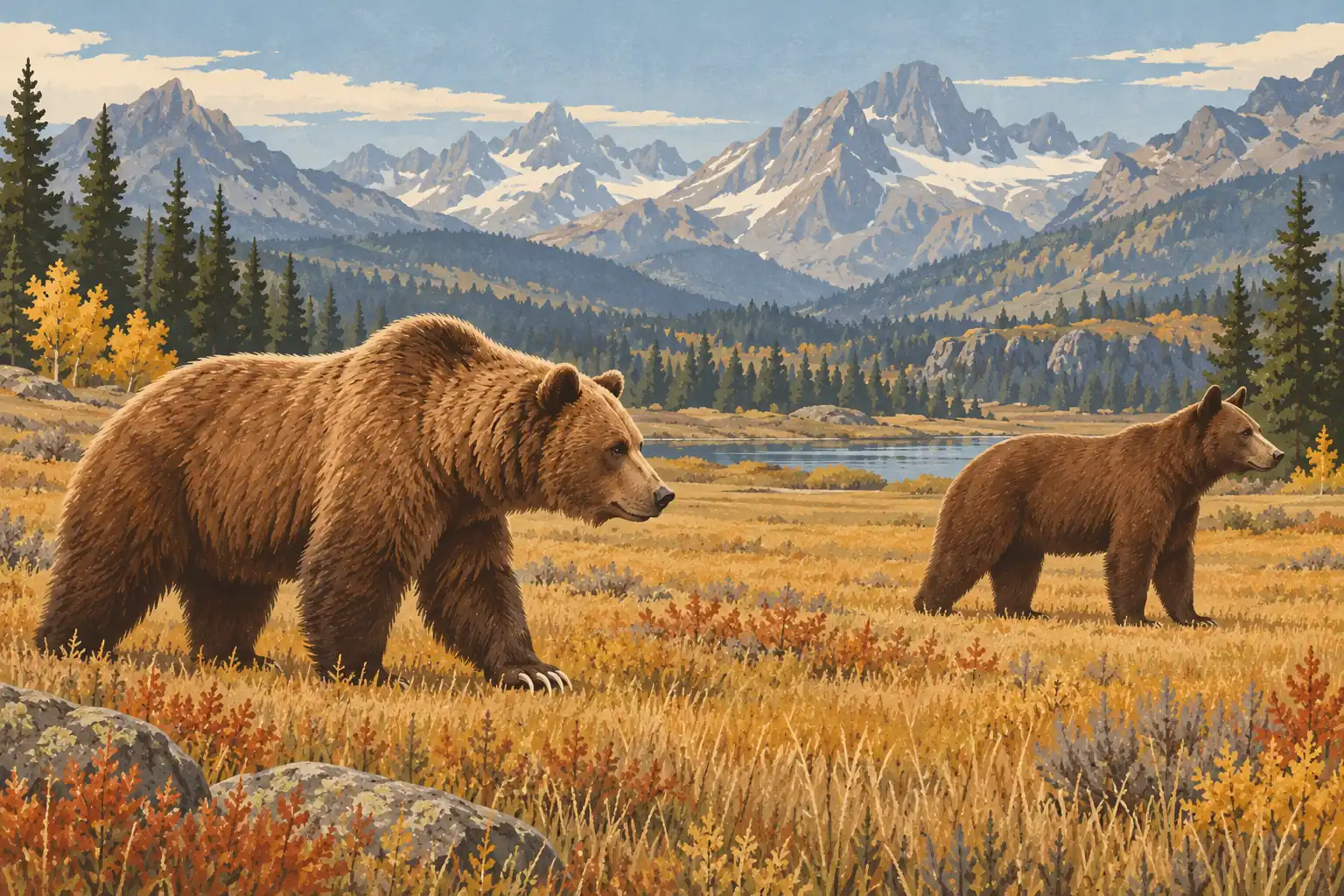
Color is a poor indicator. Some grizzlies are very dark, while some black bears are brown or cinnamon-colored. Five reliable features can help you identify the species within seconds, even from a distance.
| Feature | Grizzly | Black bear |
|---|---|---|
| Shoulder hump | Present and clearly visible between the shoulders | Absent |
| Ears | Short and rounded | Tall and upright |
| Front claws | Long (about 4 inches), straight, often light-colored and visible from a distance | Short and curved |
| Facial profile | Concave, dipping between the eyes | Convex, straight like a dog's muzzle |
| Male size (Rockies) | About 550 to 770 lb | About 200 to 310 lb |
The muscular hump between the shoulders is still the quickest giveaway: viewed from behind, a grizzly does not look like a black bear, whatever its color. Standing on its hind legs, a grizzly can reach 8 to 10 feet, compared with rarely more than 6.5 feet for a black bear. Coastal Alaska bears, fueled by salmon, can exceed 1,100 lb for males.
Where can you find each species in America’s national parks?
The two species do not share the same territory, with a few exceptions.
Grizzlies are concentrated in the northern Rockies and Alaska. In the American Rockies, they are found mainly in Yellowstone, Grand Teton, and Glacier. In Alaska, the two flagship parks are Denali and Katmai, where dozens of bears gather at Brooks Falls every summer to catch salmon, creating one of the densest bear gatherings in the world. The Greater Yellowstone Ecosystem is home to about 1,000 bears, according to 2024 NPS data, making it the largest grizzly population in the contiguous United States.
Black bears live in more than 30 parks on both coasts. Great Smoky Mountains is home to an estimated 1,900 bears, making it one of the densest black bear parks in the United States. It is also the country’s most visited national park. Yosemite is another key park for the species, and bear canisters are now required throughout its camping areas.
Keep in mind that Yellowstone and Glacier are home to both species. In these two parks, correctly identifying the bear in front of you directly determines what you should do next.
What to do when you encounter a bear: NPS guidance by species
Two rules apply to every encounter, regardless of the species. Never run: it can trigger a chase response. Never feed a bear. If you are in a group, stay together and back away slowly while speaking in a calm, quiet voice.
When facing a black bear, the NPS recommends making noise, making yourself look larger (open your arms and raise your backpack), and maintaining eye contact. If the bear attacks, fight back aggressively with anything you have: black bears back down when met with resistance. Playing dead is the wrong response to this species.
When facing a grizzly, what you should do depends on the type of attack. This distinction is the most important thing to remember before entering grizzly country.
During a defensive attack (a grizzly protecting its cubs or a carcass, or one surprised at close range), the NPS recommends lying flat on your stomach, protecting your neck with your interlaced hands, and playing dead until the animal moves away. Stay still even if the bear rolls you over.
During a predatory attack (the bear has been following you for some time, or the attack happens at night in your tent), the advice is reversed: fight back aggressively with anything you can use. A grizzly in predatory mode will not give up in the face of a passive human.
Bear spray is the deterrent recommended by the NPS for both species.
Bear spray: why you should buy it locally and how to use it
Bear spray is prohibited on airplanes, both in carry-on and checked baggage, because of its pressurized contents (under TSA and IATA regulations). You therefore need to buy it locally, at an outdoor store or the park’s visitor center. Major outdoor retailers (REI and park stores) sell models for approximately $50 to $65.
Effective range varies by model, from 23 to 39 feet. Drawing it too early disperses the spray before it reaches the bear; waiting until the animal is within 10 feet reduces its effectiveness. The technique is simple: remove the safety clip, aim slightly below the approaching bear’s muzzle, and spray in short bursts lasting one to two seconds.
The bear canister completes the safety setup. This airtight container is required for storing food overnight in several areas (Yellowstone and Yosemite). It prevents bears from associating campgrounds with food and protects your gear as well.
Bear attacks in the parks: the real numbers put the risk in perspective
America’s national parks recorded 325.5 million visits in 2023. During that same period, incidents involving a bear numbered only a few dozen per year, with just a tiny fraction resulting in serious injuries.
At Yellowstone, park reports record between 1 and 5 injuries per year, according to the park’s historical data. Nearly all documented incidents involve a solo hiker without bear spray who surprised a bear at close range.
These figures do not make the risk disappear: they put it in perspective. An average visitor who follows NPS guidance and carries bear spray reduces the risk to a marginal level, comparable to many other hazards of a road trip through the American West.
Our take: a real but manageable risk that should not stop you from traveling
First road trip in the Rockies. We recommend buying bear spray as soon as you arrive (approximately $50 to $65 at an outdoor store). The second step is to hike in a group of three or more in grizzly country such as Yellowstone and Glacier. Based on documented incidents, these are the two decisions that genuinely change the level of risk.
Family with children in eastern parks. Black bears are widespread in eastern parks (Great Smoky Mountains and Yosemite), but statistically harmless when basic rules are followed: do not feed them, and store food in a bear canister or in your vehicle overnight. Bear spray is not essential in parks without grizzlies.
What we do not recommend. Hiking alone in grizzly country without bear spray. This is the situation most often represented in documented incidents, and it is also the easiest one to avoid. Out of 325.5 million NPS visits in 2023, one to five injuries per year at Yellowstone show that the risk is marginal for anyone who does not go looking for trouble.
Frequently asked questions
Are grizzlies and brown bears the same animal?
The grizzly (Ursus arctos horribilis) is a subspecies of the brown bear (Ursus arctos). The term “grizzly” refers to populations in the American and Canadian Rockies; “brown bear” covers the species as a whole, including its Eurasian varieties and Alaska’s Kodiak bear.
Can you bring bear spray on a flight to the United States?
Bear spray is prohibited on airplanes, both in carry-on and checked baggage, because of its pressurized contents. You need to buy it locally, at an outdoor store or the park’s visitor center.
Which American national parks have grizzlies?
Grizzlies live in five major parks: Yellowstone, Grand Teton, and Glacier in the Rockies, plus Denali and Katmai in Alaska. The Greater Yellowstone Ecosystem is home to about 1,000 bears, according to 2024 NPS data, making it the largest population in the contiguous United States.
Should you react the same way to a black bear and a grizzly?
No, and this is the most important difference to remember. When facing a black bear, the NPS recommends fighting back aggressively, since the animal backs down in the face of resistance. When facing a grizzly in a defensive attack, the advice is to play dead until it leaves, then fight back if it persists.