

The World's Tallest Tree: Hyperion, General Sherman, and Methuselah
Hyperion rises 381 feet in Redwood NP, General Sherman leads by volume in Sequoia, and Methuselah is nearly 4,860 years old. Three records, three parks.
By Victoria Boissonade · · 7 min read
Hidden in Redwood National Park, in Northern California, Hyperion reaches 381 feet according to the 2019 reference measurement. It is the tallest tree in the world, and its location remains secret. It is not the only record held by America's national parks. General Sherman surpasses everything else by volume in Sequoia. Methuselah, in the White Mountains, has been alive for more than 4,850 years. Three trees, three national parks, and three ways to measure the limits of life.
Hyperion: why the world's tallest tree is off-limits
Chris Atkins and Michael Taylor discovered Hyperion on August 25, 2006, in a remote part of Redwood NP. Its height, measured in 2019, is 381 feet, making it taller than Notre-Dame de Paris's spire (315 feet in its reconstructed form). The tree belongs to the species Sequoia sempervirens, the coast redwood.
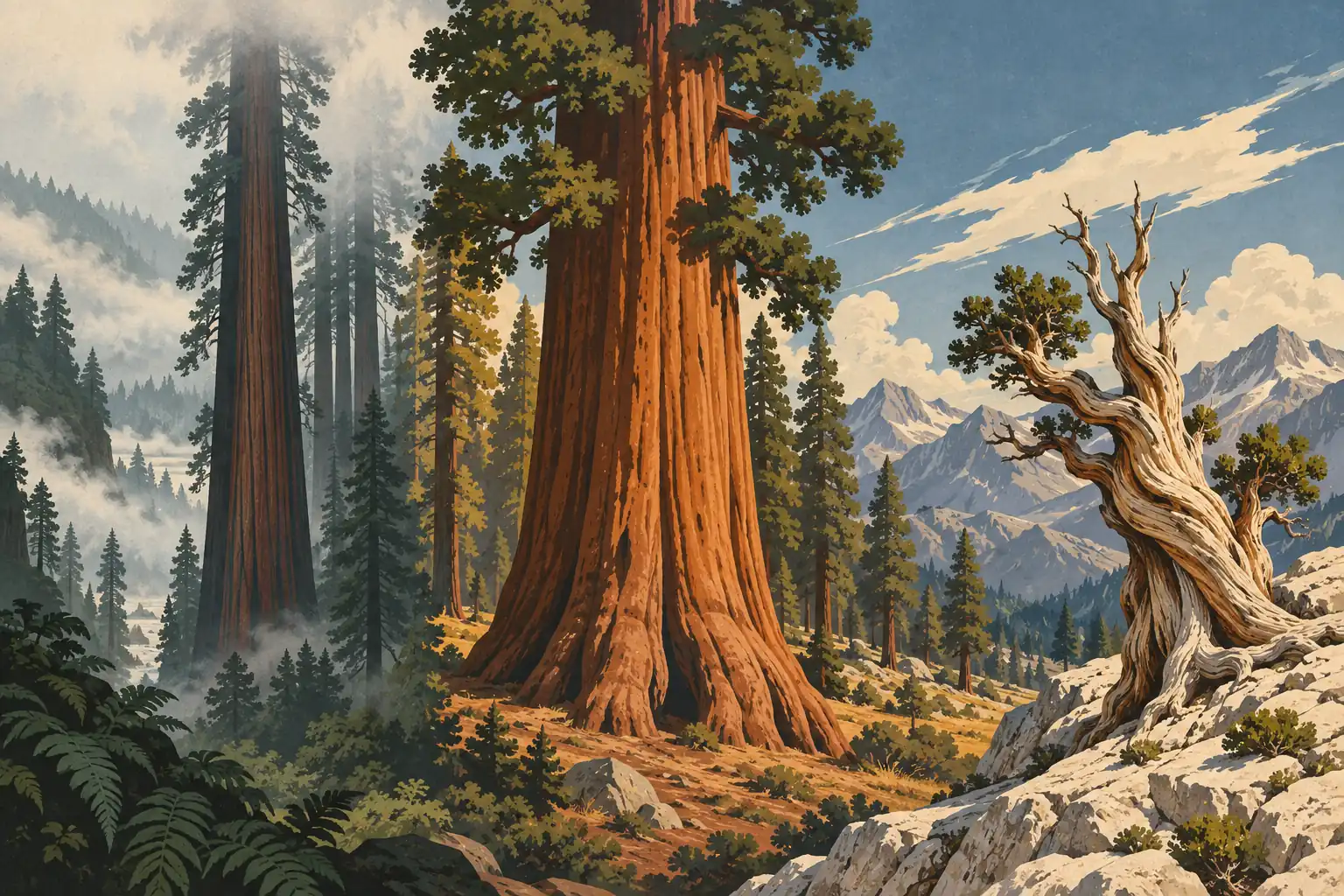
Its age is estimated at between 600 and 800 years, according to an assessment published in 2022. The crown shows signs of deterioration. Since its discovery, the NPS has never officially released its exact coordinates. Social media spread approximate directions, drawing visitors who compacted the soil and damaged the vegetation around the tree. In 2022, the NPS formalized the penalties: a $5,000 fine and up to six months in prison for anyone entering the area, according to a decision announced by Leonel Arguello, the park's chief of natural resources.
Hyperion is also approaching a physical limit documented by biologist George Koch of Northern Arizona University. His model puts the theoretical ceiling between 400 and 427 feet because hydraulic pressure can no longer lift water to the crown beyond that point. The world's tallest tree has been growing toward a boundary for centuries, but it will probably never reach it.
Coast redwood and giant sequoia: two species, two records, two parks
Confusion between the two species is common in the French-language press, where Hyperion is sometimes described as a “giant sequoia.” They are actually distinct trees with opposite growth patterns.
| Coast redwood (Sequoia sempervirens) | Giant sequoia (Sequoiadendron giganteum) | |
|---|---|---|
| Record | Height: up to 381 feet | Volume: about 52,500 cubic feet |
| Champion | Hyperion (381 feet) | General Sherman (275 feet) |
| Park | Redwood NP (Northern California) | Sequoia NP (Sierra Nevada) |
Coast redwoods grow tall and slender in the mists of the Pacific coast. Giant sequoias expand in girth in the drier Sierra Nevada. One holds the height record; the other holds the record for mass.
General Sherman, in Sequoia and Kings Canyon National Parks, stands 275 feet tall and measures 102 feet in circumference at the base. It is the largest living organism by wood volume, estimated at about 52,500 cubic feet by the NPS. In the same Giant Forest, several other giant sequoias rank among the world's largest trees by volume, making the Sierra Nevada the planet's densest concentration of these trees.
Methuselah and the bristlecone pines: the world's oldest trees
The title of world's oldest tree goes to Methuselah, a Pinus longaeva bristlecone pine estimated to be about 4,860 years old, in California's White Mountains. The U.S. Forest Service does not disclose its exact coordinates, just as with Hyperion. Signs in the Ancient Bristlecone Pine Forest identify the area without pointing to the individual tree.
Bristlecone pines grow between 9,200 and 11,800 feet above sea level, in poor limestone soils battered by the wind. This slow growth produces wood so dense that it resists fungi and insects for millennia. Ancient specimens are not anomalies. Paradoxically, they are the trees best adapted to such a harsh environment.
The story of Prometheus shows why researchers no longer core old bristlecones. In 1964, a researcher cut down a specimen in Nevada's Snake Range to extract a dendrochronological core. The rings revealed an estimated age of about 4,900 years. The oldest specimen ever dated had been destroyed before its age was known.
Great Basin National Park, in Nevada, has its own bristlecone pine forest. The Bristlecone Pine Trail (about 2.8 miles round trip) starts at the Wheeler Peak parking area at 9,800 feet above sea level, with no reservation required.
Seeing record trees the right way: three parks, three trails
These three parks fit naturally into a road trip through the American West, whether you start along the Pacific coast or in Las Vegas.
Hyperion (Redwood NP). The exact location is off-limits, and the coordinates posted online are unreliable. The Tall Trees Grove Trail (free online reservation through the Redwood Parks Conservancy) leads to coast redwoods, several of which exceed 361 feet. Helios (377 feet) and Icarus (371 feet) are in Redwood NP. Their locations are also protected, but the canopy can be seen from several official trails.
General Sherman (Sequoia NP). Direct access is via the Congress Trail, a paved 2-mile path from the Sherman Tree Trailhead, with no specific reservation. This is the most accessible of the three sites and the natural starting point from Los Angeles (about a four-hour drive).
Methuselah (Great Basin NP). Take the Bristlecone Pine Trail (about 2.8 miles round trip) from the Wheeler Peak parking area. The forest is identified, but Methuselah itself is not marked. You wander among millennia-old trees without searching for one particular specimen. No reservation is required.
Our take: three accessible parks, three verifiable records
For a first Pacific Coast road trip, we recommend prioritizing General Sherman in Sequoia NP. The Congress Trail (2 miles, paved) leads straight to the marked tree: 275 feet tall, 102 feet around, and accessible without any special preparation. It is the record that is easiest to grasp in person.
For those fascinated by longevity, Great Basin NP is worth the detour from Las Vegas (about four hours). The park remains lightly visited, and the bristlecone pine forest at 9,800 feet is breathtaking even if you do not identify Methuselah.
What we do not recommend: looking for Hyperion. The coordinates available online are unreliable, the area has been damaged, and an NPS decision announced in 2022 makes entering the area punishable by a $5,000 fine and six months in prison. The accessible coast redwoods in Redwood (Tall Trees Grove, with a free online reservation) offer a comparable experience without that risk. As with Death Valley, the appeal of a natural record is no reason to ignore the park's legal restrictions.
Frequently asked questions
What is the world's tallest tree?
Hyperion, a Sequoia sempervirens coast redwood, is the world's tallest tree: 381 feet, measured in 2019 in Redwood National Park in Northern California.
What is the difference between a coast redwood and a giant sequoia?
The difference comes down to species: Sequoia sempervirens for the former, which holds the height record in Redwood NP, and Sequoiadendron giganteum for the latter, which holds the volume record in Sequoia NP.
Can you visit Hyperion?
No, Hyperion cannot be visited. Since an NPS decision announced in 2022, entering the area has been punishable by a $5,000 fine and six months in prison.
What is the oldest tree in the world?
Methuselah, a bristlecone pine (Pinus longaeva) estimated to be about 4,860 years old, is the oldest known tree in the world. It is in California's White Mountains.
How can you see General Sherman?
General Sherman can be visited via the Congress Trail (2 miles, paved) in Sequoia National Park, starting at the Sherman Tree Trailhead. No specific reservation is required for the trail.